Fault Indicator System
Fault Current Indicator System – Technical Description
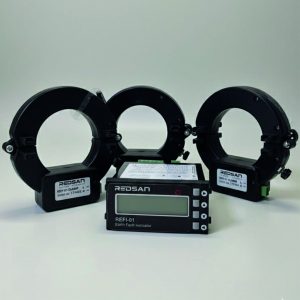
Fault current indicator system; if the set fault current threshold value persists for the detection period specified by the user, it generates an error signal. When a fault occurs, it informs the user via the internal signal LED, LCD screen and external signal lamp. Fault information can be transmitted to SCADA or other auxiliary systems via dry contact(s) on the device.
Signalling and Reset Dynamics
- LED Indicators: Signal LEDs flash every 2 seconds during the first half of the reset period and every 4 seconds during the second half. The phase or earth current symbol on the main page also flashes at the same interval as the LED to alert the user.
- Automatic Reset: The device automatically resets 3 seconds after the fault is rectified.
- Manual / Remote Reset: The user can reset the device via the interface or via an optically isolated digital input (remote reset).
- Event Log: The last 20 faults that have occurred are listed on the “Events” page, along with the current value, the faulty phase, and the date and time information.
Technical Specifications
| Parameter | Value / Property |
|---|---|
| Power supply Range | 30-265 VAC / 24-310 VDC |
| Power Consumption | < 3W |
| Battery | Lithium-ion, 3600mAh, 3.6V |
| Inputs | 3-phase current input, 24VDC digital input (optically isolated) |
| Measurement Range | 0 – 900 Amperes |
| Measured Values | Three-Phase Current (Ia, Ib, Ic), Neutral Current (In) |
| Accuracy | ± 3% |
| Outputs | 1-3 Units (Optional), SPST – NO Contact, 1A |
| Communication | Modbus RTU (RS485) |
| Baud Rate | 4800, 9600, 19200, 38400 |
| Display and Controls | 128×32 Monochrome LCD, 4 Control Buttons |
| Language Options | Turkish, English |
| Dimensions and Weight | 96x48x78 mm (Panel Type), 560 g |
| Protection and Environment | IP65 (Front Panel), -10°C / +70°C, Max. 95% Humidity |
Current Transformer Specifications
- Tip: Detachable (3 pieces)
- Dimensions: 96 x 48 x 78 mm
- Cable Diameter: 70 mm
- Nominal Current: 600A
Fault Current Indicator System – Working Principle and Application Advantages
The fault current indicator system is a microprocessor-controlled monitoring and notification device developed to quickly and accurately detect phase-to-phase or phase-to-ground faults occurring in power distribution systems. In medium-voltage and low-voltage networks, the rapid identification of the fault location is critical for operational continuity. This device continuously monitors the set threshold values and only generates a signal in the event of a genuine fault, minimising the risk of false alarms.
The system compares the measured current value with the threshold and time parameters set by the user. If the fault current persists for the specified duration, the device enters fault mode and transmits information via visual, digital and communication outputs. This structure ensures that both field personnel and central control systems are informed in real time.
Advanced Monitoring and Control Mechanism
- Real-time three-phase and neutral current measurement
- Adjustable fault current threshold
- Adjustable detection time
- Smart reset algorithm
- SCADA system integration support
The high accuracy rate (± 3%) ensures reliable measurement results. Easy integration with PLC, RTU and SCADA systems is provided via the Modbus RTU communication protocol over RS485. This feature transfers energy monitoring and fault analysis processes to a digital environment.
Benefits Provided in Energy Distribution Systems
Fault current indicators significantly reduce fault detection time, particularly in distribution lines and ring systems. Whereas in traditional methods the fault point is investigated manually by field teams, this device allows the line and phase where the fault occurred to be quickly identified.
- Reduces downtime
- Quickly pinpoints the fault location
- Reduces operating costs
- Increases energy continuity
- Maintenance planning simplifies
SCADA and Automation Integration
Thanks to Modbus RTU (RS485) communication support, fault information can be transmitted to central control rooms. The dry contact outputs on the device can be integrated with alarm systems or automation panels. This enables automatic alarm and recording systems to be activated without operator intervention.
Adjustable baud rate options (4800 – 38400) adapt to different system infrastructures. This flexibility offers advantages in both new installations and existing system modernisations.
Industrial Durability and Safe Design
The front panel design with IP65 protection rating allows for safe use in dusty and humid environments. The operating temperature range of -10°C to +70°C ensures stable performance even in harsh field conditions. With a maximum relative humidity tolerance of 95%, it is suitable for transformer stations, distribution panels and field cabinets.
Thanks to the internal lithium-ion battery (3600mAh), event records are preserved during power outages. Storing the date, time and current information for the last 20 faults greatly facilitates analysis and reporting processes.
Areas of Use
- Medium voltage distribution boards
- Transformer stations
- Ring network systems
- Industrial plant power lines
- Organised industrial zones
- Energy production and distribution companies
- Infrastructure and municipal energy systems
Why should a fault current indicator be used?
The rapid detection of faults that may occur in energy systems is of great importance in terms of both equipment safety and operational continuity. This device creates an early warning mechanism by accurately monitoring fault currents. It offers an easily observable alarm system in the field thanks to a combination of LED, LCD screen and external signal lamp.
With its compact panel design (96x48x78 mm) and weight of 560 grams, it can be easily integrated into existing panels. Its microprocessor-controlled structure ensures long-lasting and stable operation.
Fault current indicator system; as an indispensable component of modern energy monitoring systems, it is an ideal solution for a safe, efficient and sustainable energy infrastructure.